
Every Instagram creator eventually hits the same wall. Likes are climbing, comments are trickling in, but reach has flatlined and the algorithm seems to have quietly stopped caring about the account. Nine times out of ten, the missing ingredient is saves.
Saves are the quiet metric that Instagram treats as gold. A like takes half a second and means very little. A save means someone stopped scrolling, decided your post was worth keeping, and tapped a button specifically so they could come back to it later. That single action tells Instagram's algorithm this content has long-term value, and long-term value is exactly what the platform wants to keep pushing into new feeds, Explore pages, and hashtag results.
The problem is that most creators are still optimizing for likes and comments, chasing content that feels good in the moment instead of content that earns a permanent spot in someone's collection folder. This article breaks down exactly which content types consistently rack up saves, why they work from a psychological and algorithmic standpoint, and how to start producing more of them without reinventing your entire content strategy.
Why Saves Matter More Than Almost Any Other Metric
Before getting into content formats, it helps to understand why saves carry so much weight in the first place.
Instagram's ranking systems are built around predicting what will keep a user on the app longer and bring them back more often. Likes are a weak signal for this because they are cheap and impulsive. Comments are a stronger signal, but they are also noisy and can be triggered by controversy just as easily as by quality. Saves sit in a different category entirely. They represent intent. Someone is telling Instagram, in a very literal sense, "I want to see this again."
That intent gets rewarded. Posts with high save rates tend to get distributed further into the Explore tab, surface higher in relevant hashtags, and get shown to a wider slice of an account's followers instead of just the small percentage who typically see a given post. Over time, an account that consistently produces saveable content builds a reputation, in the algorithm's eyes, as a source of quality material worth recommending.
This is also why buying likes or comments has become less effective as a growth shortcut. Vanity metrics without genuine engagement depth do not move the needle the way they once did. Save-focused strategies, on the other hand, tend to compound. A small library of highly saved posts can keep generating impressions for months after publication, something that almost never happens with content optimized purely for immediate reactions.
The Psychology Behind a Save
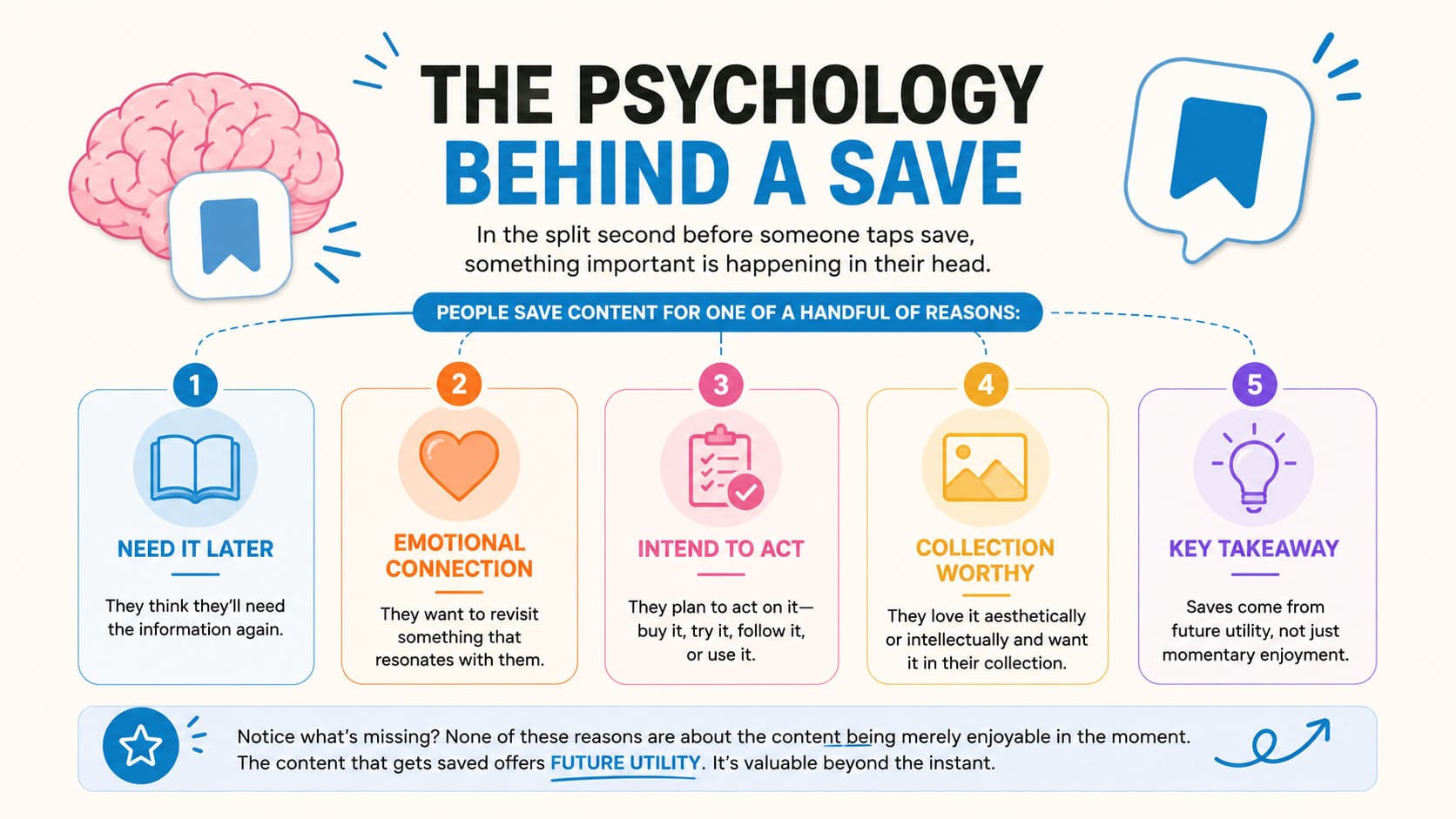
To create content people want to save, it helps to think about what actually happens in someone's head in the split second before they tap that bookmark icon.
People save content for one of a handful of reasons. They think they will need the information later. They want to revisit something emotionally resonant. They intend to act on it, whether that means buying a product, trying a recipe, or following a workout. Or they simply find it so aesthetically or intellectually satisfying that they want it in their personal collection, the same impulse that drives someone to bookmark a great article or screenshot a beautiful photo.
Notice that none of these reasons are about the content being merely enjoyable in the moment. A funny meme might get a like and a laugh, but it rarely gets saved because there is nothing to return to once the joke lands. The content types that dominate saves all share a common thread: they offer future utility. Keep that principle in mind as you read through the categories below, because it explains why each one works.
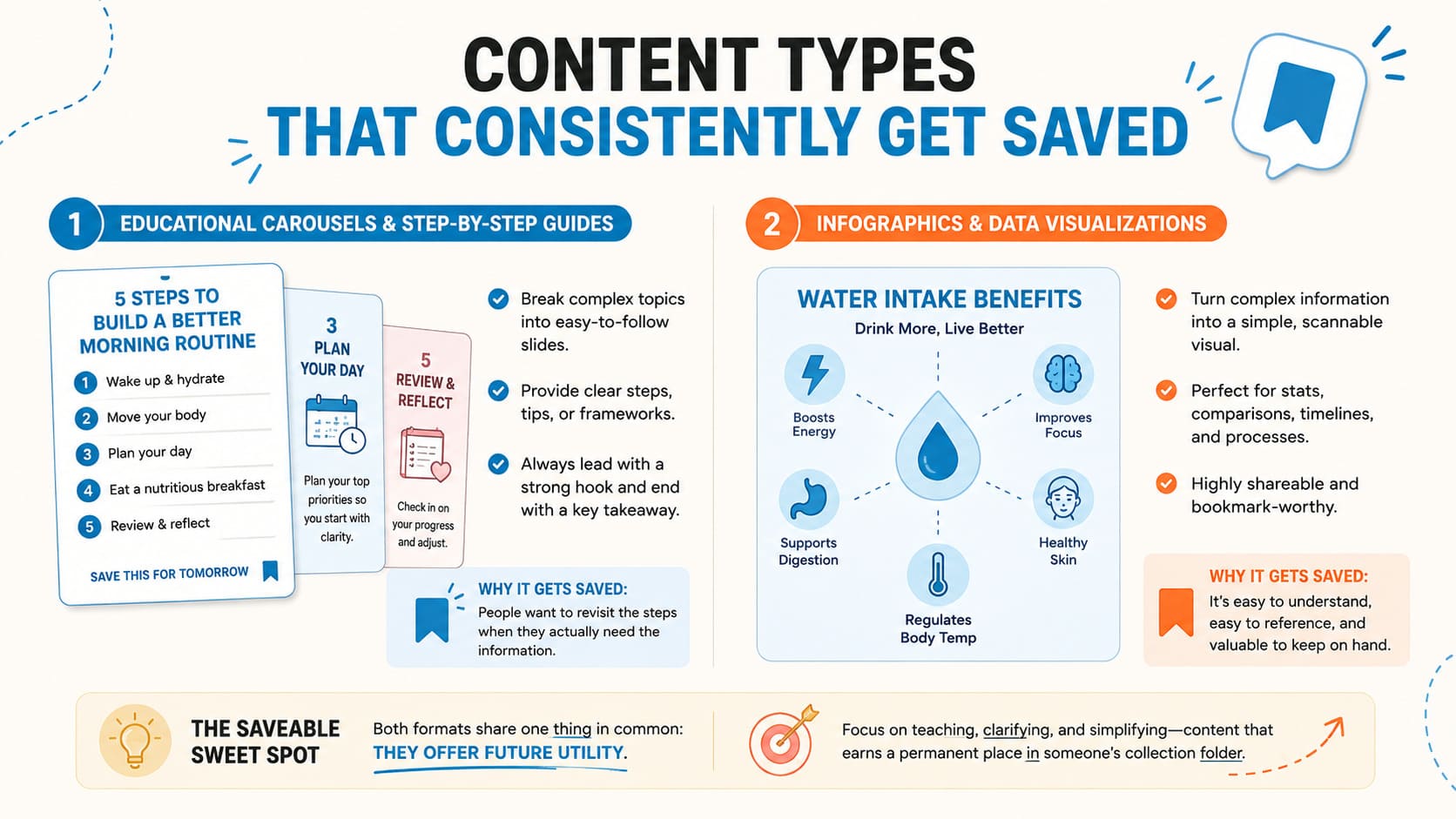
1. Educational Carousels and Step-by-Step Guides
Carousels remain one of the most reliable save-generating formats on the platform, and for good reason. A well-structured educational carousel breaks down a process, a concept, or a list of tips into digestible slides that a user can screenshot mentally or, more often, save outright to revisit when they actually need the information.
Think about the kind of content that shows up when you search "how to" anything on Instagram. Skincare routines broken into steps. Budgeting frameworks. Grammar rules for language learners. Workout progressions. These formats work because they front-load value, use the swipe mechanic to keep people engaged slide after slide, and end with something concrete enough to be useful days or weeks later.
The best educational carousels follow a simple structure: a strong hook slide that promises a specific outcome, then a logical progression of steps or points, and a closing slide that either summarizes the key takeaway or issues a soft call to action. Numbered lists tend to outperform vague advice because numbers set an expectation of completeness, which increases the odds someone will save the post to make sure they absorb everything.
2. Infographics and Data Visualizations
Closely related to carousels but distinct enough to mention on its own, the infographic format converts complex information into a single, highly shareable visual. Statistics, comparisons, timelines, and process diagrams all fall into this bucket.
Infographics get saved heavily because they compress research time. If someone can look at a single graphic and understand a comparison that would otherwise take them ten minutes of reading to piece together, that graphic becomes genuinely valuable enough to keep. This is especially true in niches like finance, health, marketing, and productivity, where audiences are constantly hunting for clear, digestible breakdowns of dense topics.
Design matters enormously here. Cluttered infographics with too much text or clashing colors tend to underperform even when the information itself is solid. Clean typography, a limited color palette, and clear visual hierarchy make the difference between a post someone scrolls past and one they stop to save.
3. Recipes and Product Round-Ups
Food content has always performed well on Instagram, but recipes specifically dominate saves because they are, by definition, meant to be used later rather than consumed in the moment. Nobody cooks a five-step pasta dish while scrolling through their feed. They save it, and they come back to it that weekend.
The same logic applies to product round-up posts: "10 skincare products under $20," "best budget kitchen tools," "must-have travel accessories." These lists function almost like a personal shopping guide, and users save them the way they would bookmark a wish list. The key to making round-ups perform is specificity. Vague recommendations get scrolled past, but precise, niche-specific picks with a clear reason for inclusion tend to earn a save because the value is immediately obvious.
4. Templates, Scripts, and Frameworks
This category has exploded in popularity over the past couple of years, particularly among business, marketing, and creator-economy accounts. Caption templates, email scripts, negotiation frameworks, content calendars condensed into a single slide, these all get saved at extremely high rates because they save the user actual work.
The appeal is obvious once you think about it from the audience's perspective. A template removes the blank-page problem. Instead of having to figure out how to write a cold outreach email from scratch, a follower can save a template post and adapt it in five minutes. That kind of practical, immediately applicable value is exactly the sort of thing the save button was built for.
5. Before-and-After Transformations
Transformation content, whether it is fitness progress, home renovations, room makeovers, or design mockups, taps into a slightly different but equally powerful save motivation: aspiration paired with proof of process. People save these posts because they want to reference the transformation later, either for inspiration or as a benchmark against their own progress.
What separates a save-worthy transformation post from a merely likeable one is context. A before-and-after photo with no explanation gets a quick like and a scroll past. The same photo paired with a breakdown of exactly what was done, what products or techniques were used, and how long it took, becomes a reference document. That added layer of information is what pushes it from "nice to look at" into "worth keeping."
6. Quote Graphics and Mindset Content
Quote posts get a bit of a bad reputation for being overused, but the format persists because it genuinely works when done well. The reason quote graphics get saved so consistently comes down to emotional utility rather than practical utility. People save quotes they want to return to during a hard day, a moment of doubt, or a burst of motivation.
The mistake many accounts make is treating quote content as filler, something to post when there is nothing else ready. High-performing quote posts are intentional. They match the tone and values of the account, they are designed with clean, legible typography, and they say something that feels specific rather than generic. A quote that could belong to any account on the platform rarely gets saved. A quote that feels like it was chosen specifically for that audience often does.
7. Checklists and Comparison Charts
Checklists function almost like a to-do list embedded inside a feed post, and that is precisely why they get saved so often. Whether it is a packing checklist for a specific type of trip, a pre-launch checklist for a small business, or a cleaning checklist broken down by room, the format gives users a reason to return to the post at the exact moment they need it, which could be days or weeks after they first saw it.
Comparison charts serve a similar function for decision-making moments. "This vs. That" breakdowns, whether comparing skincare ingredients, software tools, or workout styles, help users make a choice they were already planning to make, and they save the post so they have the comparison handy when it is time to act.
8. Long-Form Caption Storytelling Paired With Strong Visuals
While video content generally dominates reach on Instagram right now, static posts with long-form storytelling captions still perform surprisingly well on saves, particularly in niches like personal development, entrepreneurship, and mental health. A strong story, especially one with a clear lesson or turning point, gets saved because readers want to revisit the narrative or share it later with someone who needs to hear it.
The formula that tends to work best pairs a visually strong single image or simple carousel with a caption that has a clear arc: setup, challenge, resolution, takeaway. Posts that read like a mini case study or personal essay, rather than a generic caption, consistently outperform in save rate because they give the reader something substantial enough to want to keep.
Building a Content Strategy Around Saves
Once these formats click, the natural next step is figuring out how to weave them into a regular posting rhythm without burning out. A simple approach is to rotate through two or three of the highest-performing categories for your specific niche and build a repeatable production system around them. An account in the fitness space, for example, might alternate between educational carousels breaking down training concepts, before-and-after transformation posts, and checklist-style content around nutrition or gym bag essentials.
It also helps to track save rate as its own metric rather than lumping it into general engagement. Most analytics dashboards, including Instagram's native insights, break saves out separately from likes and comments. Watching that number over time reveals which specific formats and topics resonate most with a given audience, which makes future content decisions far less like guesswork.
For newer accounts or ones trying to break out of a growth plateau, early save momentum can be genuinely difficult to build simply because the algorithm has not yet learned to trust the account's content. This is one of the reasons some creators and brands choose to give a strong post an initial boost. Services like buy Instagram saves from SoldOutX are built around exactly this problem: giving a well-made, save-worthy post the early signal it needs so the algorithm starts distributing it more widely before organic saves have had time to catch up. It is not a replacement for creating genuinely useful content, but paired with the formats above, it can help a post reach the audience it deserves faster.
Common Mistakes That Kill Save Potential
A few recurring mistakes show up across accounts that struggle to generate saves despite putting real effort into their content.
The first is burying the value too deep. If a carousel takes five slides to get to the actual point, most users will drop off before they ever see the reason to save it. Front-loading the payoff, or at least clearly signaling it in the hook slide, keeps people swiping until they reach the part worth keeping.
The second is producing content that is entertaining but disposable. A funny skit or a trending audio clip might rack up views and likes, but if there is nothing to return to once the moment has passed, it will almost never generate meaningful saves. That is not a reason to avoid entertaining content entirely, but it is worth balancing with formats that offer lasting utility.
The third is neglecting design quality on information-heavy posts. An infographic or carousel packed with genuinely useful information can still underperform if it is hard to read, cluttered, or visually inconsistent. Since saves often happen because someone plans to reference the post again, the content needs to be easy to scan and absorb quickly, not just accurate.
Finally, many accounts fail to explicitly cue the save action. A simple line in the caption, something like "save this for later" or "bookmark this before you forget," sounds almost too simple to matter, but it consistently increases save rates because it reminds users of an action they were already inclined to take.
Final Thoughts
Saves are one of the clearest signals a creator has that their content is genuinely working, not just performing well in the moment but earning a lasting place in someone's feed habits. Educational carousels, infographics, recipes, templates, transformations, quote graphics, checklists, and strong long-form storytelling all share the same underlying principle: they give the audience a reason to come back.
Shifting content strategy toward these formats will not happen overnight, and it does not mean abandoning entertaining or trend-driven posts altogether. It means being intentional about building a steady stream of content that offers real, lasting value alongside the lighter material. Over time, that shift tends to show up not just in the save count, but in reach, follower growth, and the overall health of an account's relationship with the algorithm.
Interested in exploring further? The articles below expand on this topic with additional insights, practical examples, and helpful resources to keep you moving forward.