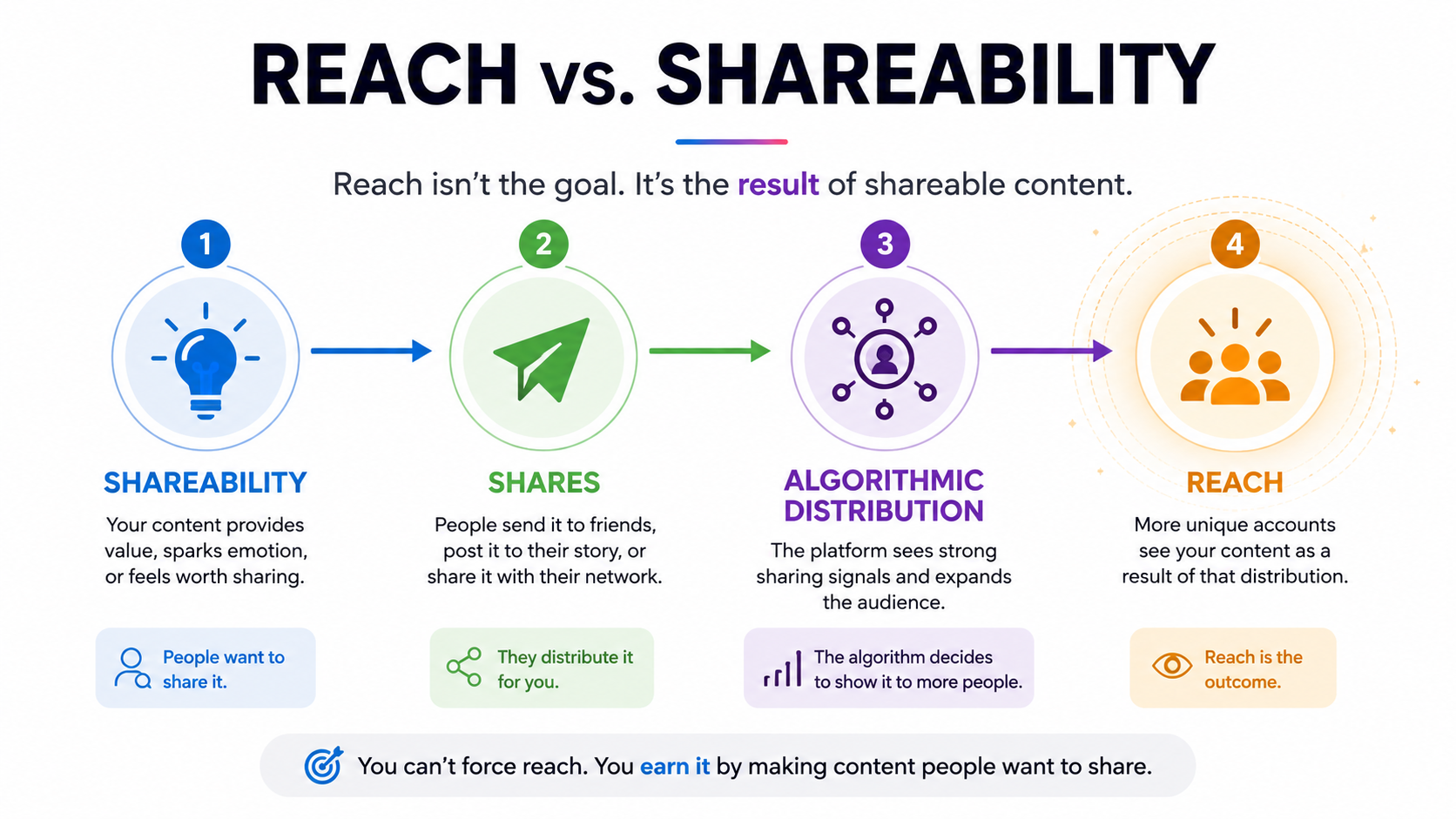
Every creator obsesses over one number when a post underperforms: reach. It feels like the obvious culprit. Not enough people saw the post, so it must have failed. But reach is a symptom, not a cause. It is the platform's response to something that happened earlier in the content's life, and that something is almost always shareability.
If you have ever posted content that got a healthy number of likes but never really took off, while a much rougher, less polished post from a smaller account spread everywhere, you have already seen this in action. The difference wasn't luck. It was shares. Understanding why platforms treat shares as a far stronger signal than reach, and why reach is actually downstream of shareability, changes how you plan content from the first draft.
What Reach Actually Measures
Reach is the number of unique accounts that saw a piece of content. That's it. It doesn't tell you whether those people cared, whether they stopped scrolling, or whether the content meant anything to them. Reach is a distribution metric, not a quality metric, and treating it as a goal in itself is one of the most common mistakes creators and brands make.
Here's the part that surprises most people: reach is not something the algorithm decides upfront and then measures the outcome of. It's closer to the opposite. Platforms like Instagram, TikTok, and Facebook run a small initial test batch of any given post, showing it to a limited slice of your followers or a small test audience outside your following. What happens during that test window determines how far the post travels next. Reach expands or contracts based on performance signals collected in those first minutes and hours. Reach is the output of the test, not the input.
This is why chasing reach directly rarely works. You cannot force a platform to distribute content widely by wanting it to. You can only influence the behaviors that make the platform decide, on its own, that wider distribution is worth it.
Why Shares Outweigh Likes and Views
Not all engagement signals are treated equally, and platforms have gotten increasingly transparent about this over the past few years. Adam Mosseri, the head of Instagram, has said publicly on multiple occasions that shares and sends are among the strongest signals the platform uses to decide what to recommend, because they represent a much higher bar of intent than a like.
Think about the effort involved in each action. A like takes a fraction of a second and often happens passively while someone is barely paying attention. A share requires a person to make a small but real decision. They have to believe the content is worth someone else's time, choose a specific person or group to send it to, or decide it's worth putting on their own story or feed. That is a much stronger endorsement than a tap.
Platforms weight actions by the cost of performing them, and shares are expensive in attention terms. When a user shares something, they are putting their own reputation behind it in some small way. They are telling a friend, a group chat, or their own audience, "this is worth your time." Algorithms interpret that as a much higher confidence signal than a like, because it predicts future behavior more reliably. A person who shares content is statistically far more likely to be a predictor of what other people will also want to see.
This is the mechanical reason shareability drives distribution more than almost any other factor. It's not a philosophy. It's how the ranking systems are built.
The Feedback Loop Between Shares and Reach
Once you understand that shares are a leading indicator and reach is a lagging one, the relationship becomes clear. A piece of content with a high share rate in its first hour tells the platform something important: people are actively distributing this for us. The algorithm responds by expanding the audience it's shown to, which naturally increases reach. More reach usually produces more shares in absolute numbers, which reinforces the loop, and the post keeps climbing.
Compare that to a post that gets plenty of likes but very few shares. The algorithm reads this as content that people enjoyed passively but didn't feel compelled to pass along. Distribution flattens out quickly because there's no compounding signal pushing it further.
This explains a pattern that confuses a lot of creators: two posts with nearly identical like counts can have wildly different total reach. The gap is almost always explained by share rate, not by luck or timing. One post gave people a reason to hit send. The other one didn't.
What Actually Makes Content Shareable
If shares are the real engine, the next question is what makes someone want to share something in the first place. This has been studied extensively in marketing research, most notably by Jonah Berger, whose work on virality identifies a consistent set of triggers. A few of the most relevant for social content:
- Practical value. Content that saves someone time, teaches a skill, or solves a small problem gets shared because sharing it makes the sharer look helpful.
- Emotional intensity. High-arousal emotions, whether that's awe, humor, anger, or surprise, drive sharing far more than low-arousal emotions like contentment or sadness.
- Social currency. People share things that make them look smart, in the know, or ahead of the curve. Niche or insider content performs well here.
- Identity alignment. Content that reflects a belief, value, or aesthetic someone wants to be associated with gets sent to reinforce that identity.
- Story structure. Content built around a clear narrative, even a short one, holds attention long enough to reach the point where someone decides to pass it on.
Notice that none of these are about production quality. A shaky, unpolished video that makes someone laugh out loud will consistently outperform a beautifully shot post that produces no reaction at all. This is why smaller accounts sometimes outperform much larger ones on individual pieces of content. Shareability is not correlated with budget. It's correlated with whether the content gives someone a reason to act.
Reach Without Shareability Is a Dead End
There's a temptation to think you can buy your way around this by simply pushing more reach through paid promotion or aggressive posting frequency. That approach has a ceiling. Paid reach can put content in front of eyes, but it cannot manufacture the behavioral signal that keeps the algorithm expanding distribution organically once the paid boost ends. If a promoted post doesn't generate shares and saves on its own, performance drops the moment spend stops.
This is also why organic growth strategies that focus purely on follower count or impressions without addressing the underlying content quality tend to plateau. A large follower base helps a post get its initial test audience, which matters, but it doesn't guarantee the share rate that determines what happens next. This is one of the reasons a lot of accounts trying to grow their profile look at services that combine both sides of the equation. Getting an initial audience boost through something like buying Instagram shares can help a post clear that early signal threshold the algorithm is testing for, but it works best as a supplement to genuinely shareable content, not a substitute for it.
How to Design Content for Shareability, Not Just Reach
Once shareability becomes the goal instead of reach, the content planning process changes in a few concrete ways.
Lead with the hook that earns the share, not just the view. Most creators optimize the first three seconds purely to stop the scroll. That matters, but it's only half the job. The content also needs a moment, usually within the first ten to fifteen seconds, where the viewer thinks "someone needs to see this." That moment is what triggers the share, not the hook alone.
Build in a clear send-to-a-friend prompt. This sounds simple, but explicitly framing content as something to tag a friend in, or send to a specific type of person, measurably increases share rate. It removes the ambiguity of "should I share this" by answering the question for the viewer.
Favor specificity over broad appeal. Content that tries to appeal to everyone often appeals strongly to no one. Highly specific content, a joke that only makes sense to people in a certain profession, a tip that only matters to a certain hobby, tends to generate higher share rates within its niche because it feels tailor-made rather than generic.
Use formats that are inherently shareable. Carousels, infographics, and short how-to clips tend to outperform single static images on share rate because they package information in a way that's easy to forward as a complete unit. A screenshot of a single useful slide from a carousel spreads on its own.
Track share rate as its own metric. Most analytics dashboards bury shares under a general engagement tab. Pull it out and track shares as a percentage of reach, not just a raw number. A post with 5,000 views and 200 shares is performing at a much higher level than a post with 50,000 views and 150 shares, even though the second post looks bigger on the surface.
Saves Are the Quiet Cousin of Shares
It's worth mentioning saves alongside shares, because platforms treat them similarly, even if the psychology is slightly different. A save signals that someone found the content valuable enough to want to return to it, which is a strong quality signal even without the social distribution component of a share. Content that ranks high in both saves and shares tends to get the most sustained algorithmic support, because it satisfies two different signals at once: personal value and social value.
If you're auditing content performance, look at posts that have unusually high save-to-reach ratios and unusually high share-to-reach ratios separately. They often reveal two different content strategies working simultaneously, and understanding which one is driving a given post's success helps you replicate it intentionally instead of guessing.
Common Mistakes That Keep Reach Artificially Low
A few patterns show up repeatedly in accounts that struggle with reach despite decent content quality.
Posting content with no clear reaction built in. Content that is pleasant but not surprising, funny, useful, or emotionally charged rarely earns a share, because there's nothing prompting the viewer to act.
Ignoring the first hour. Because the algorithm tests content on a small audience first, engagement in that early window matters disproportionately. Posting at a time when your actual audience is inactive means the test batch produces weak signals before the content ever gets a real chance.
Over-indexing on aesthetics. Highly polished content can sometimes read as promotional rather than authentic, which lowers the perceived social currency of sharing it. A slightly rougher, more personal format often performs better specifically because it feels like something a real person would send to a friend, not a brand asset.
Treating captions as an afterthought. The caption often carries the specific hook or context that turns a passive viewer into an active sharer. A strong visual paired with a flat caption leaves value on the table.
Bringing It Together
Reach tells you how far something traveled. Shares tell you why. If you want to consistently grow, the strategy has to start with the second question, not the first. Build content that gives people an unmistakable reason to send it, tag someone in it, or put it on their own story, and reach becomes a natural consequence rather than a goal you're chasing directly.
This doesn't mean reach doesn't matter, or that supporting tools have no place in a growth strategy. A wider starting audience can help new content clear the early testing phase the algorithm runs on every post, which is part of why services built around growing that base, including tools like Instagram share growth, get used alongside organic content planning rather than instead of it. But the long-term compounding effect, the kind that turns one good post into a consistent growth pattern, comes from shareability. That's the lever that actually moves the algorithm, because it's the lever the algorithm was built to watch.
The creators and brands who understand this stop asking "how do I get more reach" and start asking "what would make someone stop and send this to a friend right now." That single shift in framing changes everything downstream of it, including the reach number everyone was chasing in the first place.
Before you go, take a look at these related reads. They're carefully selected to help you explore connected topics and uncover even more useful information.