
Instagram has trained most of us to chase likes and comments, but the platform stopped weighing those metrics as heavily years ago. If you've been watching your engagement numbers and wondering why a post with hundreds of likes barely moved the needle on reach, the answer is usually hiding in two metrics people rarely check: saves and shares.
Both actions look similar on the surface. Someone taps a button instead of just scrolling past. But Instagram's algorithm treats them very differently, and understanding that difference can completely change how you plan content. This guide breaks down what saves and shares actually measure, why the algorithm cares about each one separately, and how to build a content strategy that earns both.
Why Instagram Moved Past Likes
Likes are cheap. A double-tap takes less than a second and requires almost no thought. Because of that, likes tell Instagram very little about whether content is genuinely useful or worth showing to more people. Anyone can like a post out of habit while barely reading the caption.
Saves and shares require more intent. A save means someone wants to come back to a post later. A share means someone thought the content was worth putting in front of another person, whether that's a friend, a follower, or their entire audience. Both of these actions carry more weight in Instagram's ranking system because they reflect actual value, not just a passive reaction.
This is why creators who obsess over follower counts and like totals often plateau, while accounts with smaller followings but strong save and share rates keep growing. The algorithm is not asking "how many people reacted?" It's asking "how many people found this valuable enough to act on?"
What a Save Actually Tells Instagram
When someone saves your post, they're bookmarking it for later. That single action sends a very specific signal: this content has lasting value. It's not a joke that gets a laugh and gets forgotten. It's a recipe, a workout routine, a product recommendation, a tutorial, or a piece of advice that someone wants to reference again.
Saves tell Instagram three things at once:
The content is useful, not just entertaining. Entertainment gets likes and quick comments. Utility gets saves. If your post teaches something, solves a problem, or organizes information in a way people want to keep, it's a strong candidate for saves.
The audience trusts the source. People don't save random accounts. They save creators and brands they consider reliable enough to revisit. A high save rate is often a proxy for authority within a niche.
The content has a longer shelf life. A save signals that a post isn't just relevant today, it's relevant next week or next month. Instagram uses this to justify showing older saved posts back to users through Explore and search results, which is part of why well-saved content can keep generating impressions long after it was published.
Because saves reflect this kind of durable value, Instagram treats a healthy save rate as one of the clearest indicators that a post deserves wider distribution. Some creators and agencies choose to jumpstart that signal early by using a service like buy Instagram saves, which gives newer content an initial base of save activity so the algorithm has something to work with before organic saves start rolling in. It's a similar logic to seeding any new piece of content: the earlier a post shows healthy engagement, the more likely the algorithm is to test it in front of a wider audience.
What a Share Actually Tells Instagram
A share works differently. Instead of keeping content for personal use, the person is actively distributing it, either to their own Story, to a specific friend through DMs, or to a group chat. Shares are a social signal rather than a personal one.
Here's what a share communicates to the algorithm:
The content resonated emotionally. People share things that make them laugh, feel seen, feel angry, or feel inspired. Shares are less about "I want to remember this" and more about "someone else needs to see this."
The content has conversation potential. A share to DM often kicks off a private conversation. Instagram can't read those messages, but it can track that a share happened, and it interprets that as a sign the content sparked interaction beyond the platform's public engagement layer.
The content reaches new audiences organically. When someone shares a post to their Story, it appears to their entire follower list, some of whom may not follow the original account. This is one of the few ways content spreads without paid promotion or algorithmic boosting, and Instagram tends to reward posts that demonstrate this kind of organic reach because it extends the platform's own network effects.
Shares tend to spike for content that's relatable, funny, surprising, or emotionally charged. Memes, quote graphics, before-and-after transformations, and "this is so me" style posts typically perform well here because they're built for that split-second decision to tap "send to."
The Core Difference: Personal Value vs Social Value
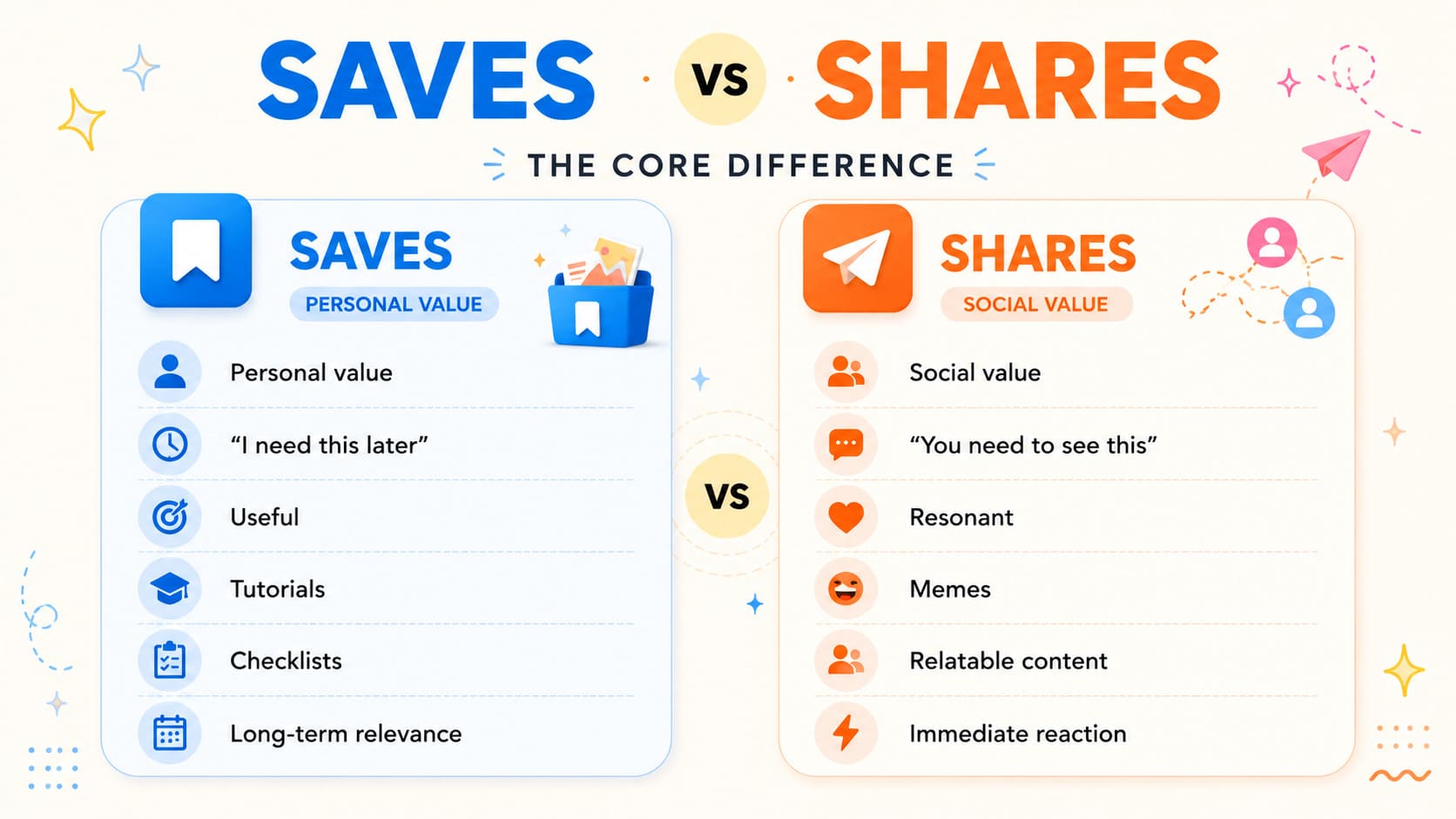
If you strip away the mechanics, the difference between saves and shares comes down to this: a save is about personal value, and a share is about social value.
When someone saves a post, they're thinking about themselves and their own future needs. When someone shares a post, they're thinking about someone else and how that person might react. These are two very different psychological triggers, and they call for two very different types of content.
This is why a single post rarely dominates both metrics. A dense, informative carousel about budgeting tips will usually get saved far more than shared, because most people don't send financial advice to friends unprompted. Meanwhile, a funny relatable meme about Monday mornings will get shared constantly but saved rarely, because nobody needs to keep it for later.
Understanding this distinction helps creators stop treating engagement as one big number and start treating it as two separate goals that require two separate content approaches.
Content Types That Drive Saves
Some formats are naturally built for saving. If you want to increase your save rate, these are worth prioritizing:
How-to and tutorial content. Step-by-step guides, whether it's a skincare routine, a recipe, or a home organization hack, are classic save magnets. People save these because they intend to follow the steps later, not right now.
List-based carousels. "5 apps every freelancer needs" or "7 mistakes new gym-goers make" format posts work well because they package multiple useful points into a single, scannable piece of content that feels worth revisiting.
Reference material. Cheat sheets, checklists, and infographics that condense information into an easy-to-scan format tend to get saved at high rates because they function like a personal library entry.
Product roundups and recommendations. Posts that compile useful tools, products, or resources often get saved because people want to come back and actually buy or try them later, not necessarily the moment they see the post.
Long captions with genuine substance. A caption that goes deep on a topic, rather than just a one-liner, gives people a reason to save the post so they can finish reading or reread it properly later.
The common thread across all of these formats is that they reward a second look. If a post only makes sense in the moment, it won't get saved. If it holds up over time, it will.
Content Types That Drive Shares
Shares live in a different emotional register. The formats that tend to perform well here include:
Relatable humor. Content that captures a shared experience, an awkward moment, a universal frustration, tends to spread quickly because tagging a friend in the comments or sending it directly feels natural.
Surprising or unexpected content. Anything that makes someone stop and think "wait, really?" tends to get forwarded because people like being the one who shares something new.
Emotionally charged storytelling. Posts that tell a compelling personal story, especially ones with an unexpected twist or an emotional payoff, often get shared because people want others to feel what they just felt.
Quote graphics and affirmations. Simple, well-designed text posts that put a feeling into words are extremely shareable, particularly in Stories, because they let the sharer express something about themselves without writing it out.
Timely or newsworthy content. Posts that tie into a current event, trend, or cultural moment tend to get shared quickly because there's urgency behind the "you have to see this" instinct.
Shareable content usually asks less of the viewer than saveable content. It doesn't require action later, it just requires a reaction now, strong enough that the person wants someone else to feel it too.
How to Build Content That Earns Both
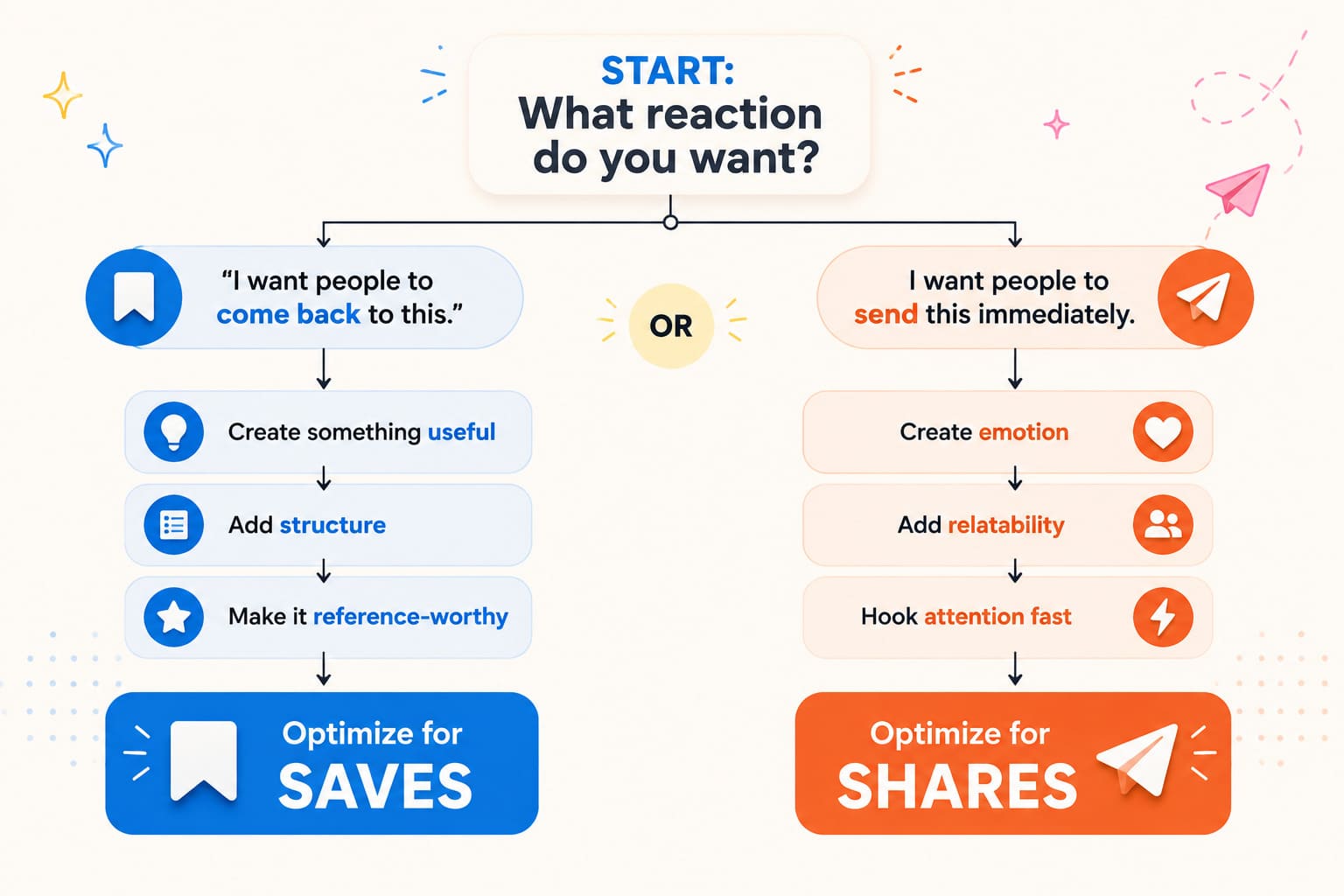
The best-performing accounts don't pick a lane and stay there. They build a content mix that alternates between save-driven and share-driven posts, because relying on just one signal leaves the algorithm with an incomplete picture of your account's value.
A practical way to approach this is to plan content in categories rather than one post at a time. Before publishing, ask which bucket a piece of content falls into:
- Is this something people will want to reference later? Lean into structure, clarity, and depth. Think carousels, checklists, and detailed captions.
- Is this something people will want to send to a friend right now? Lean into emotion, humor, or a strong visual hook that works in the first two seconds.
Some formats can actually do both if they're built carefully. A well-designed infographic, for example, might get saved because it's useful and shared because it's visually striking enough that someone wants a friend to see it too. These dual-purpose posts tend to be some of the highest performing content on the platform, precisely because they trigger both signals at once.
It also helps to look at your own historical data. Instagram Insights shows saves and shares separately for every post, and reviewing which of your past posts performed well on each metric will usually reveal patterns specific to your audience and niche that generic advice can't predict.
Why the Algorithm Rewards Both Signals Together
It's tempting to ask which metric matters more, but that's the wrong framing. Instagram doesn't rank content based on a single winning signal. It looks at the overall engagement profile of a post, and posts that show strength across multiple signals, saves, shares, comments, and watch time for video, tend to outperform posts that spike on just one.
A post with an enormous save count but almost no shares tells Instagram that the content is useful to the people who already found it, but it isn't spreading. A post with tons of shares but very few saves tells Instagram the content is entertaining in the moment but forgettable. Neither profile is a red flag on its own, but a post that earns both is a much stronger candidate for the Explore page and hashtag search results, since it demonstrates value to the individual viewer and to their broader network.
This is also why new accounts and newer posts often struggle to gain traction. Without an existing base of engagement, there's nothing for the algorithm to evaluate in those crucial first hours after posting. This is part of why many creators build an early engagement foundation, sometimes through organic outreach to their existing audience, sometimes by using tools like buy Instagram saves to establish that initial signal, so that the content has a fighting chance to be tested against a wider audience before it disappears into the feed.
Common Mistakes Creators Make With These Metrics
Even creators who know the difference between saves and shares often misread what their own numbers are telling them. A few mistakes come up repeatedly.
Treating every post like it should hit both metrics equally. Not every piece of content needs to be a save-and-share hybrid. Forcing a tutorial to be funny, or forcing a meme to include a lesson, usually waters down both goals instead of strengthening either one. It's fine, and often better, to let a post lean clearly into one lane.
Ignoring saves because they're less visible. Shares show up in Stories and DMs, so they feel more tangible. Saves happen silently, with no public trace, which makes them easy to undervalue. But because saves are a stronger indicator of long-term usefulness, dismissing them in favor of more visible metrics can lead to a content strategy that chases short-term spikes instead of steady, compounding growth.
Confusing reach with quality. A post can go semi-viral through shares without actually representing your brand well. Shares spread fast, but if the underlying content doesn't reflect what an account is really about, the new visitors it attracts may not convert into long-term followers. Save-heavy content, by contrast, tends to attract an audience that's already aligned with what the account offers, since people don't bookmark things they don't find personally relevant.
Not adjusting captions to match the goal. A caption written for a save-driven post should usually end with an explicit prompt, something like "save this for later," since research on user behavior consistently shows that direct prompts increase the likelihood of an action. Share-driven posts benefit more from captions that ask the reader to tag someone or pass it along, since that framing nudges the exact behavior the format is built for.
Publishing without checking the analytics from the last cycle. Instagram Insights breaks saves and shares out separately for every post and Reel. Skipping that data means repeating the same content mix indefinitely instead of refining it based on what the audience actually responds to.
How to Track Saves and Shares Effectively
Tracking these metrics doesn't require anything beyond what's already built into Instagram, but it does require a consistent process.
Start by reviewing performance weekly rather than per post. A single post's numbers can be misleading, especially early on, but a week's worth of data shows real patterns. Look specifically at which formats consistently rank high on saves and which consistently rank high on shares, then compare that against what you originally intended each post to do.
It also helps to segment by content pillar. If your account covers more than one topic, saves and shares often behave differently across those pillars. A fitness account, for example, might see workout tutorials dominate saves while transformation reels dominate shares. Recognizing that split lets you plan each pillar with the right goal in mind instead of applying one blanket strategy across everything you post.
Finally, pay attention to the relationship between saves, shares, and reach over time. Posts that combine strong numbers on both metrics tend to show a longer reach curve, meaning they keep gaining impressions days or even weeks after publishing rather than peaking in the first 24 hours. That extended curve is one of the clearest practical signs that the algorithm is actively continuing to test and promote a post.
Frequently Asked Questions
Do saves count more than shares in the Instagram algorithm? Instagram has never published exact weightings, but based on how creators observe reach patterns, saves tend to correlate strongly with sustained distribution because they signal lasting value. Shares tend to correlate more with short bursts of reach as content moves through Stories and DMs. Neither consistently outweighs the other; they usually work together.
Can a post get a lot of shares but still perform poorly overall? Yes. A post can spread quickly through shares without building a save rate or driving profile visits, which can result in a short-lived spike rather than sustained growth. This is one reason it's worth building content that gives people a reason to save it as well as send it.
Is it normal for save rates to be lower than share rates? It depends heavily on content type. Entertainment-first accounts often see shares outperform saves by a wide margin, while education or reference-based accounts usually see the opposite. Comparing your numbers to a general industry benchmark is less useful than comparing them to your own account's history.
How quickly does Instagram evaluate saves and shares after posting? Most of the meaningful evaluation window happens within the first few hours after publishing, though well-performing posts can continue collecting saves and shares for days or weeks. That's part of why an early boost in either metric can meaningfully affect how far a post travels.
Should Reels be optimized differently than static posts for saves and shares? The core principles stay the same, but Reels tend to skew toward shares because of how easily they move through Stories and the Reels tab itself. Static carousels, on the other hand, tend to skew toward saves because they're built for slower, more deliberate consumption. Adjusting expectations by format helps avoid misreading performance.
Practical Takeaways
If there's one thing worth remembering from all of this, it's that saves and shares are not interchangeable, and they're not competing metrics. They're two separate conversations your content can have with your audience.
A save says "I might need this again." A share says "someone else needs to see this now." Building a content calendar that speaks to both of those instincts, rather than optimizing for a single vague idea of "engagement," is one of the most reliable ways to grow sustainably on Instagram in a landscape where the algorithm keeps shifting what it rewards.
Track both metrics separately in your analytics. Notice which of your content types lean save-heavy and which lean share-heavy. Then, instead of guessing, build your next few weeks of content with intention: a mix of reference-worthy, save-driven posts and emotionally resonant, share-driven posts. Over time, that balance is what turns a good content strategy into one the algorithm actively wants to promote.
Keep the momentum going with these handpicked articles. Each one offers valuable insights and actionable takeaways to help you deepen your understanding.