

Every marketer has stared at a piece of content that flopped and wondered why. The visuals were sharp, the copy was clean, and the topic was relevant, yet it barely moved. Meanwhile, a rough video shot on a phone racks up hundreds of thousands of shares overnight. The difference usually has nothing to do with production value and everything to do with psychology.
Shareability is not an accident. It is a set of repeatable principles rooted in how people think, feel, and present themselves to their social circles. When you understand what actually drives someone to hit "share," you stop guessing and start engineering content that spreads on its own.
This guide breaks down exactly how to make content people want to share, using research-backed psychology, proven formats, and practical steps you can apply to your next post today.
Why People Share Content in the First Place
Before diving into tactics, it helps to understand the underlying motivation. Researchers at the University of Pennsylvania studied thousands of New York Times articles to figure out what made content go viral, and the findings were consistent: people share content that makes them look good to others.
Sharing is a form of self-expression. When someone shares a post, they are not just passing along information. They are telling their audience something about who they are: smart, funny, generous, in-the-know, or emotionally aware. If your content doesn't help someone build or reinforce their identity, it is much less likely to get passed along.
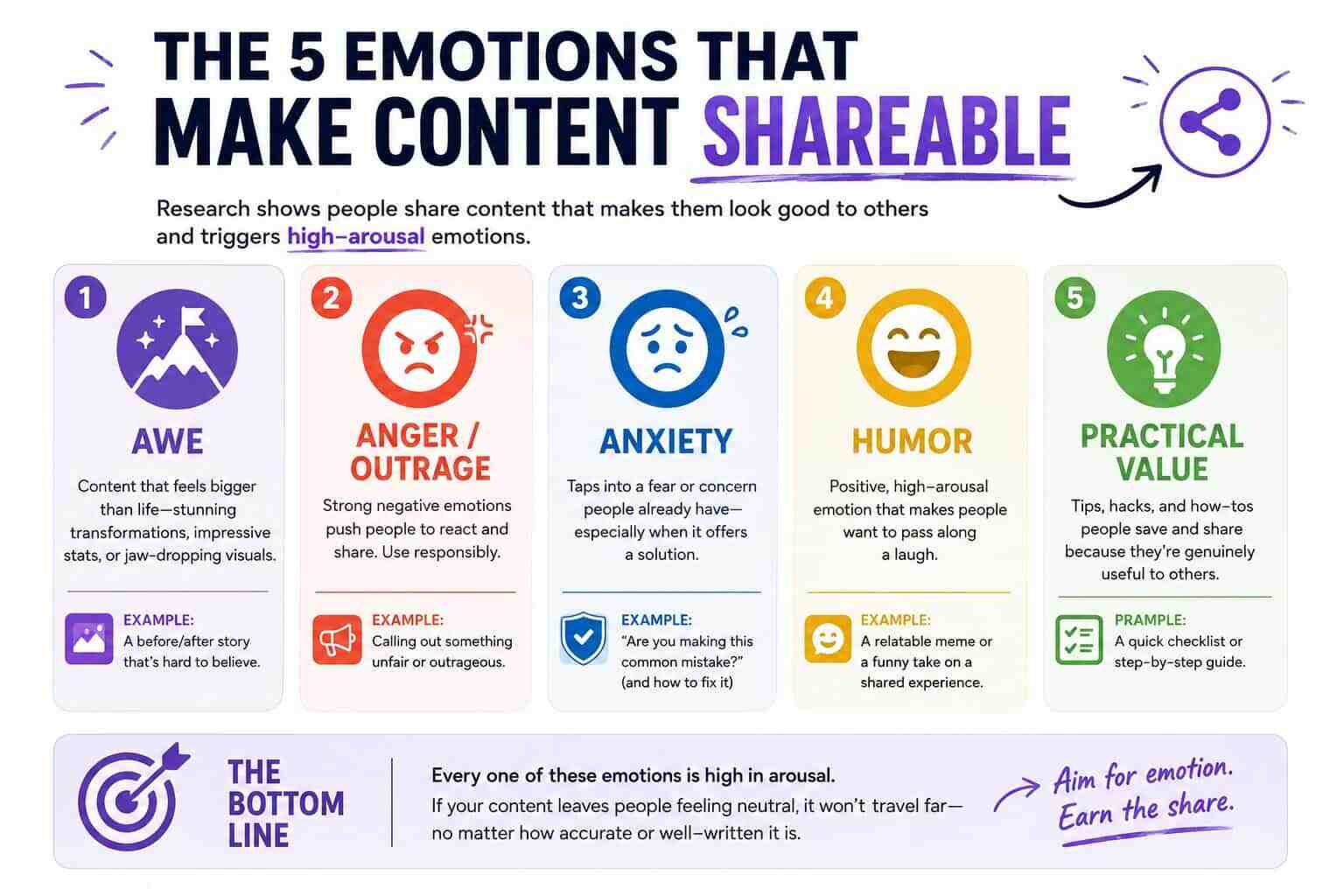
Beyond identity, five core emotional drivers show up again and again in shareability research:
- Awe – Content that feels bigger than life, whether that's a stunning transformation, an impressive statistic, or a jaw-dropping visual.
- Anger or outrage – Strong negative emotions with high arousal push people to react and share, though this comes with reputational risk if used carelessly.
- Anxiety – Content that taps into a fear or concern people already have, especially when it offers a solution.
- Humor – Positive, high-arousal emotion that makes people want to pass along a laugh.
- Practical value – Tips, hacks, and how-tos that people save and share because they are genuinely useful to someone else in their circle.
Notice the pattern: every one of these emotions is high in arousal. Calm, low-energy emotions like contentment rarely drive sharing behavior. If your content leaves people feeling neutral, it will not travel far, no matter how accurate or well-written it is.
Start With a Hook That Earns Attention in Seconds
Attention online is measured in fractions of seconds, so the first line, first frame, or first three seconds of your content has to do the heavy lifting. This applies whether you are writing a blog post, filming a Reel, or drafting a caption.
A strong hook usually does one of the following:
- Asks a question the reader already wants answered
- States a surprising fact or statistic
- Promises a clear, specific outcome
- Creates a small information gap that the rest of the content resolves
Weak hook: "Today I want to talk about content marketing." Strong hook: "This one caption format got a small account 40,000 shares in a week."
The strong version works because it is specific, it implies a result, and it creates curiosity about the mechanism behind that result. Specificity almost always outperforms vague statements in headlines, captions, and video hooks.
Build Content Around a Clear Emotional Core
Every piece of content, no matter the format, benefits from having one dominant emotion at its center. Trying to hit five emotions at once usually dilutes all of them. Pick the emotion that fits your message and lean into it deliberately.
If you are writing a how-to guide, practical value and mild anxiety relief (solving a problem) work well together. If you are telling a brand story, awe or warmth tends to land better. If you are commenting on an industry trend, a touch of controlled outrage or contrarian opinion can spark discussion, as long as it is grounded in a real point of view rather than manufactured drama.
A simple test before publishing: read your content back and ask, "What is the one feeling I want someone to have when they finish this?" If you cannot answer that in one sentence, the content probably needs another pass.
Make It Easy to Consume and Even Easier to Pass Along
Complexity kills shareability. People do not share content they have to work to understand, because sharing something confusing reflects poorly on them.
A few structural habits that make content easier to share:
- Short paragraphs and sentences. Break up dense blocks of text so the eye can move quickly.
- Clear formatting. Subheadings, bullet points, and bold text let readers skim and still get the point.
- One core idea per piece. If your post tries to cover ten unrelated tips, none of them stick. A tightly focused piece around a single insight is far more memorable.
- A quotable line. Give readers a sentence they can lift and drop into a caption or comment. If you write one line that sounds good on its own, people will screenshot it.
On visual platforms like Instagram and TikTok, this same principle applies to design. Clean typography, high contrast, and a clear focal point make a graphic or video far more likely to get reposted to a Story or sent in a DM, which is one of the most common forms of sharing today.
Use Formats That Are Built to Be Shared
Some content formats are inherently more shareable than others because they map directly onto the reasons people share in the first place.
Listicles and frameworks work because they package practical value in an easy-to-scan structure. "7 signs your content strategy needs a reset" promises quick, actionable value.
Before-and-after content taps into awe and curiosity. Transformations, whether physical, financial, or creative, are some of the most consistently shared formats across every platform.
Data-driven posts borrow credibility. A statistic-backed claim feels safer to share because it positions the sharer as informed rather than opinionated.
Relatable humor travels fast because it is low-risk and high-reward for the person sharing it. A joke that resonates with a niche audience often outperforms polished, "serious" content from the same account.
Behind-the-scenes content builds a parasocial connection. People share it to feel like insiders and to bring their friends into that same feeling.
Testing a mix of these formats over time, rather than betting everything on one style, gives you a clearer picture of what your specific audience responds to.
Write Captions and Headlines That Do Half the Work
On social platforms, the caption or headline often decides whether someone even sees the rest of your content, since it is what shows up in the feed before a tap or a click. A few proven techniques:
- Lead with the payoff, not the setup. Tell people what they'll get before you explain how you got there.
- Use numbers. "5 ways," "in 3 steps," and "10 minutes" all signal a clear, digestible structure.
- Ask a direct question. Questions naturally invite a response, which boosts engagement signals that platforms reward with more distribution.
- Avoid clickbait that doesn't deliver. A caption that overpromises and underdelivers damages trust and reduces future shares, even if it drives a short-term spike.
Small wording changes can have an outsized impact. Testing two or three caption variations before settling on one is a habit worth building into your content process.
Timing and Distribution Still Matter
Even the most shareable content underperforms if it is posted when your audience is offline or if the platform's algorithm never gets a chance to show it to enough people. A few practical steps:
- Post when your specific audience is most active, not just at generic "best times to post" windows found in blog posts.
- Give new content an initial push through your most engaged followers, since early engagement signals often determine how far a platform distributes a post afterward.
- Repurpose strong-performing content across formats. A blog post can become a carousel, a carousel can become a Reel script, and a Reel can become a quote graphic.
This is also where account health plays a bigger role than most creators expect. A post from an account with a strong, active follower base tends to get an early engagement boost simply because more real people see it in the first hour, and that early momentum is what platform algorithms use to decide whether to push content further. Brands and creators who are rebuilding momentum after a slow patch sometimes use a service like SoldOutX's Instagram share growth to strengthen that early distribution signal, which then gives genuinely well-made content a better shot at reaching new audiences organically instead of getting lost in a crowded feed.
Tell a Story Instead of Listing Facts
Human brains are wired to remember and pass along stories far more readily than they retain isolated facts. If you can wrap your message in a small narrative arc, even a two-sentence one, it becomes more memorable and more shareable.
A simple structure that works across almost any topic:
- Setup – What was the situation before?
- Tension – What problem, obstacle, or surprise showed up?
- Resolution – What changed, and what did you learn?
This works for a case study, a personal post, or even a short caption. "I posted every day for 30 days and got almost nothing. Then I changed one thing about my hook, and my reach tripled in a week" is a far more shareable sentence than "Hooks are important for reach," even though both statements make the same point.
Add Social Proof Without Being Pushy
People are more likely to share content that has already been validated by others. This is the psychological principle of social proof, and it shows up in a few practical ways:
- Visible engagement (likes, comments, shares) signals to new viewers that the content is worth their time.
- Testimonials, reviews, and user-generated content borrow trust from real people instead of the brand itself.
- Comments that ask questions or add value extend the life of a post, since replying keeps it active in the algorithm.
Encouraging early comments, whether by asking a direct question in the caption or replying quickly to the first few people who engage, can meaningfully change how a piece of content performs over its first hour, which is often the window that determines its overall reach.
Test, Measure, and Refine
No one gets shareable content right on the first attempt every time. The creators and brands who consistently produce content that spreads are the ones who treat every post as a small experiment.
A simple system to follow:
- Track share rate, not just likes or views, since shares are the clearest signal that content resonated enough for someone to pass it along.
- Note which hooks, formats, and emotional angles consistently outperform others for your specific audience.
- Retire formats that underperform, even if they worked for a competitor or a different niche.
- Revisit old high-performing content periodically and update it, since a proven structure often works again with a fresh angle.
Over a few months, this kind of ongoing testing builds a much clearer picture of what actually moves your audience than any general best-practices list, including this one, can provide on its own.
Common Mistakes That Kill Shareability
A few habits consistently hold content back from spreading, even when the core idea is solid:
- Trying to appeal to everyone. Content aimed at a broad, generic audience usually resonates with no one in particular. Niche, specific content travels further within its intended circle.
- Burying the point. If someone has to read three paragraphs before understanding what the content is actually about, most will drop off before they reach it.
- Ignoring mobile formatting. The vast majority of shares happen on mobile devices, so content that looks great on a desktop screen but breaks down on a phone loses a large share of its potential reach.
- Forgetting the call to action. Simply asking people to share, tag a friend, or send it to someone who needs to see it can measurably increase share rates, since it removes the guesswork about what to do next.
Putting It All Together
Making content people want to share comes down to a few core principles repeated consistently: tap into a real emotion, keep the message clear and specific, format it so it is easy to consume and pass along, and give people a reason to feel good about sharing it with their own network.
None of this requires massive production budgets or a huge following to start. It requires a clear understanding of your audience, a willingness to test different formats and hooks, and the discipline to keep refining based on what the data actually shows rather than what you assume will work.
Combine that consistent content strategy with strong foundational distribution, whether that comes from organic community building, paid promotion, or a service that strengthens your account's early reach and social proof, and shareable content stops being a lucky accident. It becomes a repeatable system you can rely on with every new post.
Continue your learning journey with the articles below. Whether you're looking for deeper explanations, practical tips, or fresh ideas, you'll find more valuable content waiting for you.